
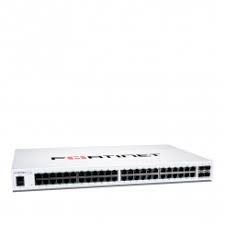
FortiSwitch -148F Secure Access
The FortiSwitch™ Access Family is tailored to meet the unique demands of enterprise branch offices and small businesses. An unparalleled combination of security, ease of use, and scalability makes FortiSwitch™ the ideal choice for Ethernet infrastructure.
Description
Secure Networking Through Forti Link
- Forti Link is an innovative proprietary management protocol that enables seamless integration and management between a FortiGate Next-Generation Firewall and the Forti Switch Ethernet switching platform. By using Forti Link, the Forti Switch becomes a logical extension of the FortiGate, allowing for centralized management of both network security and access layer functions through a single interface.
Easy-to-use Network Access Control (NAC) at No Cost
- Forti Link integration enables basic NAC functionality to profile and securely onboard devices as they connect. Forti Link NAC offers visibility into all connected devices, automated segmentation and security policies for IoT devices, quarantine if compromised, and virtual patching to help protect against threats.
Built-in Ethernet Port Security
- Traditional Ethernet port security demands manual effort and continuous maintenance, which is impractical for IT administrators of remote branches or small business. Consequently, Ethernet ports are frequently left unprotected. Forti Switch access switching offers IT administrators the ability secure ports ensuring only approved users and devices get access to the network. The automation of port security without requiring 802.1x makes making policy enforcement easy to implement and manage while NGFW-level policies ensure granular control and zero-trust access for users and devices.
User- and Device-Based Access Control and Policy Enforcement
- Whether leveraging Fortinet Identity Access Management (IAM) or third-party identity providers, Forti Link automation can leverage user identity to make granular role-based policy decisions, allowing you to implement zero-trust principles.
Secure Access Service Edge (SASE)
- This Forti Switch enterprise architecture offers a built-in foundation for zero-trust network access (ZTNA) and secure access service edge (SASE), offering the flexibility to easily deploy the type and level of security you need at the edge of your network.
Operational Simplicity
- Deploying, managing, and perfecting an Ethernet switching infrastructure can be challenging and time-consuming, particularly when done remotely or with limited staff. Forti Switch switching architecture can be securely deployed and managed in minutes through zero-touch deployment. Whether Forti Switch is deployed in standalone mode or Forti Link mode, its easy-to-use intuitive workflows and unified views let you provision, manage, and optimize your small business or remote branches at scale. Whether cloud or on-premises, centralized management delivers a unified view of the LAN, security, and in the case of SD-Branch: SD-WAN and 5G wireless gateways. This feature provides a consistent user experience for optimal operational efficiency, simplifying management, optimization, and troubleshooting. The result is a shorter mean time to repair both network and security issues.
Scalable and Flexible for Branches or Small Business
- Forti Switch access architecture scales to meet the need of today’s small business and remote branches without sacrificing security. Supporting up to 48 ports in a compact 1 RU form factor, Forti Switch can deliver the performance and scale you require.
Eliminate Bottlenecks
- With wire speed 1GE access ports and dedicated uplinks capable of speeds up 10GE, the Forti Switch Access Series provides the performance and speed needed for next generation SD-Branch applications.
Next-Generation Power Over Ethernet Support
- With PoE+ support in all models, Forti Switch delivers and manages power for devices such as cameras, sensors, and wireless access points.
Features
Management and Configuration
- Auto Discovery of Multiple Switches
- Automated detection and recommendations
- Centralized VLAN Configuration
- Dynamic Port Profiles for FortiSwitch ports
- FortiLink Secure Fabric
- FortiLink Stacking (Auto Inter-Switch Links)
- FortiSwitch Management over VXLAN
- Health Monitoring
- IGMP Snooping
- L3 Routing and Services (FortiGate)
- Link Aggregation Configuration
- LLDP/MED
- Managed Switches 8 to 300 depending on FortiGate model
- Policy-Based Routing (FortiGate)
- Provision firmware upon authorization
- Software Upgrade of Switches
- Spanning Tree
- Switch POE Control
- Virtual Domain (FortiGate)
High Availability
- Active-Active Split LAG from FortiGate to FortiSwitches for Advanced Redundancy
- LAG support for FortiLink Connection
- Support FortiLink FortiGate in HA Cluster
Security and Visibility
- Authentication 802.1X (Port-based, MAC-based, MAB)
- Block Intra-VLAN Traffic
- Clients Monitoring
- Device Detection
- DHCP Snooping
- DHCP/ARP Monitor
- FortiGuard IoT identification
- FortiSwitch recommendations in Security Rating
- Host Quarantine on Switch Port
- Integrated FortiGate Network Access Control (NAC) function
- MAC Black/While Listing (FortiGate)
- NAC Device Telemetry
- Network Device Detection
- Policy Control of Users and Devices (FortiGate)
- Port Statistics
- Security Fabric Automation
- Switch Controller traffic collector
- Syslog Collection
UTM Features
- Firewall (FortiGate)
- IPC, AV, Application Control, Botnet (FortiGate)
Layer 2
- Auto-negotiation for Port Speed and Duplex
- Auto topology
- Dynamically shared packet buffers
- Edge Port / Port Fast
- IEEE 802.1ad QinQ
- IEEE 802.1AX Link Aggregation
- IEEE 802.1D MAC Bridging/STP
- IEEE 802.1Q VLAN Tagging
- IEEE 802.1s Multiple Spanning Tree Protocol (MSTP)
- IEEE 802.1w Rapid Spanning Tree Protocol (RSTP)
- IEEE 802.3 10Base-T
- IEEE 802.3ab 1000Base-T
- IEEE 802.3ad Link Aggregation with LACP
- IEEE 802.3ae 10 Gigabit Ethernet
- IEEE 802.3az Energy Efficient Ethernet
- IEEE 802.3ba, 802.3bj, and 802.3bm 40 and 100 Gigabit Ethernet
- IEEE 802.3bz Multi Gigabit Ethernet
- IEEE 802.3 CSMA/CD Access Method and Physical Layer Specifications
- IEEE 802.3u 100Base-TX
- IEEE 802.3x Flow Control and Back-pressure
- IEEE 802.3z 1000Base-SX/LX
- Ingress Pause Metering
- Jumbo Frames
- LAG min/max bundle
- Loop Guard
- MAC, IP, Ethertype-based VLANs
- MDI/MDIX Auto-crossover
- Per-port storm control
- Priority-based Flow Control (802.1Qbb)
- Private VLAN
- Rapid PVST interoperation
- Spanning Tree Instances (MSTP/CST)
- Storm Control
- STP BPDU Guard
- STP Root Guard
- Time-Domain Reflectcometry (TDR) Support
- Unicast/Multicast traffic balance over trunking port
- (dst-ip, dst-mac, src-dst-ip, src-dst-mac, src-ip, src-mac)
- Virtual-Wire
- VLAN Mapping
Services
- IGMP proxy / querier
- IGMP Snooping
- MLD proxy / querier
- MLD Snooping
Layer 3
- Bidirectional Forwarding Detection (BFD)
- DHCP Relay
- DHCP server
- Dynamic Routing Protocols: OSPFv2, RIPv2, VRRP, ISIS *
- Filtering routemaps based on routing protocol
- IP conflict detection and notification
- IPv6 route filtering
- Static Routing (Hardware-based)
- Unicast Reverse Path Forwarding - uRPF
Security and Visibility
- ACL
- ACL Multiple Ingress
- ACL Multistage
- ACL Schedule
- Admin Authentication Via RFC 2865 RADIUS
- Assign VLANs via Radius attributes (RFC 4675)
- DHCP-Snooping
- Dynamic ARP Inspection
- Flow Export (NetFlow and IPFIX)
- IEEE 802.1ab Link Layer Discovery Protocol (LLDP)
- IEEE 802.1ab LLDP-MED
- IEEE 802.1ae MAC Security (MAC Sec)
- IEEE 802.1X Authentication MAC-based
- IEEE 802.1X Authentication Port-based
- IEEE 802.1X Dynamic VLAN Assignment
- IEEE 802.1X EAP pass-through
- IEEE 802.1X Guest and Fallback VLAN
- IEEE 802.1X MAC Access Bypass (MAB)
- IEEE 802.1X open auth
- IP source guard
- IPv6 RA Guard
- LLDP-MED ELIN support
- MAC-IP Binding
- Per-port and per-VLAN MAC learning limit
- Port Mirroring
- Radius Accounting
- Radius CoA (Change of Authority)
- sFlow
- Sticky MAC and MAC Limit
- Wake on LAN
- *Requires ‘Advanced Features’ License.
High Availability
- Multi-Chassis Link Aggregation (MCLAG)
Quality of Service
- Egress priority tagging
- Explicit Congestion Notification
- IEEE 1588 PTP (Transparent Clock)
- IEEE 802.1p Based Priority Queuing
- IP TOS/DSCP Based Priority Queuing
- Percentage Rate Control
Management
- Automation Stitches
- Display Average Bandwidth and Allow Sorting on Physical Port / Interface Traffic
- Dual Firmware Support
- HTTP / HTTPS
- IPv4 and IPv6 Management
- Link Monitor
- Managed from FortiGate
- Packet Capture
- POE Control Modes
- Provide warning if L2 table is getting full
- RMON Group 1
- SNMP v1/v2c/v3
- SNMP v3 traps
- SNTP
- Software download/upload: TFTP/FTP/GUI
- SPAN, RSPAN, and ERSPAN
- Standard CLI and Web GUI Interface
- Support for HTTP REST APIs for Configuration and Monitoring
- Syslog UDP/TCP
- System alias command
- System Temperature and Alert
- Telnet / SS
RFC and MIB Support*
BFD
- RFC 5880: Bidirectional Forwarding Detection (BFD)
- RFC 5881: Bidirectional Forwarding Detection (BFD) for IPv4 and IPv6 (Single Hop)
- RFC 5882: Generic Application of Bidirectional Forwarding Detection (BFD)
BGP
- RFC 1771: A Border Gateway Protocol 4 (BGP-4)
- RFC 1965: Autonomous System Confederations for BGP
- RFC 1997: BGP Communities Attribute
- RFC 2545: Use of BGP-4 Multiprotocol Extensions for IPv6 Inter-Domain Routing
- RFC 2796: BGP Route Reflection - An Alternative to Full Mesh IBGP
- RFC 2842: Capabilities Advertisement with BGP-4
- RFC 2858: Multiprotocol Extensions for BGP-4
- RFC 4271: BGP-4
- RFC 6286: Autonomous-System-Wide Unique BGP Identifier for BGP-4
- RFC 6608: Subcodes for BGP Finite State Machine Error
- RFC 6793: BGP Support for Four-Octet Autonomous System (AS) Number Space
- RFC 7606: Revised Error Handling for BGP UPDATE Messages
- RFC 7607: Codification of AS 0 Processing
- RFC 7705: Autonomous System Migration Mechanisms and Their Effects on the BGP
- AS_PATH Attribute
- RFC 8212: Default External BGP (EBGP) Route Propagation Behavior without Policies
- RFC 8654: Extended Message Support for BGP
DHCP
- RFC 2131: Dynamic Host Configuration Protocol
- RFC 3046: DHCP Relay Agent Information Option
- RFC 7513: Source Address Validation Improvement (SAVI) Solution for DHCP
IP/IPv4
- RFC 2697: A Single Rate Three Color Marker
- RFC 3168: The Addition of Explicit Congestion Notification (ECN) to IP
- RFC 5227: IPv4 Address Conflict Detection
- RFC 5517: Cisco Systems' Private VLANs: Scalable Security in a Multi-Client Environment
- RFC 7039: Source Address Validation Improvement (SAVI) Framework
IP Multicast
- RFC 2710: Multicast Listener Discovery (MLD) for IPv6 (MLDv1)
- RFC 3569: An Overview of Source-Specific Multicast (SSM)
- RFC 4541: Considerations for Internet Group Management Protocol (IGMP) and Multicast
- Listener Discovery (MLD) Snooping Switches
- RFC 4605: Internet Group Management Protocol (IGMP)/Multicast Listener Discovery
- (MLD)-Based Multicast Forwarding (“IGMP/MLD Proxying”)
- RFC 4607: Source-Specific Multicast for IP
IPv6
- RFC 2464: Transmission of IPv6 Packets over Ethernet Networks: Transmission of IPv6
- Packets over Ethernet Networks
- RFC 2474: Definition of the Differentiated Services Field (DS Field) in the and IPv6
- Headers (DSCP)
- RFC 2893: Transition Mechanisms for IPv6 Hosts and Routers
- RFC 4213: Basic Transition Mechanisms for IPv6 Hosts and Router
- RFC 4291: IP Version 6 Addressing Architecture
- RFC 4443: Internet Control Message Protocol (ICMPv6) for the Internet Protocol Version
- 6 (IPv6) Specification
- RFC 4861: Neighbor Discovery for IP version 6 (IPv6)
- RFC 4862: IPv6 Stateless Address Auto configuration
- RFC 5095: Deprecation of Type 0 Routing Headers in IPv6
- RFC 6724: Default Address Selection for Internet Protocol version 6 (IPv6)
- RFC 7113: IPv6 RA Guard
- RFC 8200: Internet Protocol, Version 6 (IPv6) Specification
- RFC 8201: Path MTU Discovery for IP version 6
IS-IS
- RFC 1195: Use of OSI IS-IS for Routing in TCP/IP and Dual Environments
- RFC 5308: Routing IPv6 with IS-IS
MIB
- RFC 1213: MIB II parts that apply to FortiSwitch 100 units
- RFC 1354: IP Forwarding Table MIB
- RFC 1493: Bridge MIB
- RFC 1573: SNMP MIB II
- RFC 1643: Ethernet-like Interface MIB
- RFC 1724: RIPv2-MIB
- RFC 1850: OSPF Version 2 Management Information Base
- RFC 2233: The Interfaces Group MIB using SMIv2
- RFC 2618: Radius-Auth-Client-MIB
- RFC 2620: Radius-Acc-Client-MIB
- RFC 2665: Definitions of Managed Objects for the Ethernet-like Interface Types
- RFC 2674: Definitions of Managed Objects for Bridges with Traffic Classes, Multicast
- Filtering and Virtual LAN extensions
- RFC 2787: Definitions of Managed Objects for the Virtual Router Redundancy Protocol
- RFC 2819: Remote Network Monitoring Management Information Base
- RFC 2863: The Interfaces Group MIB
- RFC 2932: IPv4 Multicast Routing MIB
- RFC 2934: Protocol Independent Multicast MIB for IPv4
- RFC 3289: Management Information Base for the Differentiated Services Architecture
- RFC 3433: Entity Sensor Management Information Base
- RFC 3621: Power Ethernet MIB
- RFC 6933: Entity MIB (Version 4)
OSPF
- RFC 1583: OSPF version 2
- RFC 1765: OSPF Database Overflow
- RFC 2328: OSPF version 2
- RFC 2370: The OSPF Opaque LSA Option
- RFC 2740: OSPF for IPv6
- RFC 3101: The OSPF Not-So-Stubby Area (NSSA) Option
- RFC 3137: OSPF Stub Router Advertisement
- RFC 3623: OSPF Graceful Restart
- RFC 5340: OSPF for IPv6 (OSPFv3)
- RFC 5709: OSPFv2 HMAC-SHA Cryptographic Authentication
- RFC 6549: OSPFv2 Multi-Instance Extensions
- RFC 6845: OSPF Hybrid Broadcast and Point-to-Multipoint Interface Type
- RFC 6860: Hiding Transit-Only Networks in OSPF
- RFC 7474: Security Extension for OSPFv2 When Using Manual Key Management
- RFC 7503: OSPF for IPv6
- RFC 8042: CCITT Draft Recommendation T.4
- RFC 8362: OSPFv3 Link State Advertisement (LSA) Extensibility
OTHER
- RFC 2030: SNTP
- RFC 3176: InMon Corporation's sFlow: A Method for Monitoring Traffic in Switched and
- Routed Networks
- RFC 3768: VRRP
- RFC 3954: Cisco Systems NetFlow Services Export Version 9
- RFC 5101: Specification of the IP Flow Information Export (IPFIX) Protocol for the
- Exchange of Flow Information
- RFC 5798: VRRPv3 (IPv4 and IPv6)
RADIUS
- RFC 2865: Admin Authentication Using RADIUS
- RFC 2866: RADIUS Accounting
- RFC 4675: RADIUS Attributes for Virtual LAN and Priority Support
- RFC 5176: Dynamic Authorization Extensions to Remote Authentication Dial In User
- Service (RADIUS)
RIP
- RFC 1058: Routing Information Protocol
- RFC 2080: RIPng for IPv6
- RFC 2082: RIP-2 MD5 Authentication
- RFC 2453: RIPv2
- RFC 4822: RIPv2 Cryptographic Authentication
SNMP
- RFC 1157: SNMPv1/v2c
- RFC 2571: Architecture for Describing SNMP
- RFC 2572: SNMP Message Processing and Dispatching
- RFC 2573: SNMP Applications
- RFC 2576: Coexistence between SNMP versions
Hardware Specifications
Total Network Interfaces
- 48x GE RJ45 and 4x 10GE SFP+
Dedicated Management 10/100 Port
- 0
RJ-45 Serial Console Port
- 1
Form Factor
- 1 RU Rack Mount
Power over Ethernet (PoE) Ports
- 0
PoE Power Budget
- 0
Mean Time Between Failures
- > 10 years
System Specifications
Switching Capacity (Duplex)
- 176 Gbps
Packets Per Second (Duplex)
- 260 Mpps
MAC Address Storage
- 32 K
Network Latency
- < 1µs
VLANs Supported
- 4 K
Link Aggregation Group Size
- 8
Total Link Aggregation Groups
- 16
Packet Buffers
- 2 MB
Memory
- 512 MB DDR3
Flash
- 64 MB
ACL
- 640
Spanning Tree Instances
- 32
Dimensions
Height x Depth x Width (inches)
- 1.73 x 10.24 x 17.32
Height x Depth x Width (mm)
- 44 x 260 x 440
Weight
- 7.63 lbs (3.46 kg)
Environment
Power Required
- 100–240V AC, 50-60 Hz
Power Supply
- AC built in
Redundant Power
- No
Power Consumption* (Average / Maximum)
- 55.8 W / 57 W
Heat Dissipation
- 194.37 BTU/h
Operating Temperature
- 32°F to 113°F (0°C to 45°C)
Storage Temperature
- -4°F to 158°F (-20°C to 70°C)
Humidity
- 10% to 90% non-condensing
Air-Flow Direction
- side-to-side
Noise Level
- 42.8 dBA
Ordering Information
Fortinet Corporate Social Responsibility Policyrn
- Fortinet is committed to driving progress and sustainability for all through cybersecurity, with respect for human rights andrnethical business practices, making possible a digital world you can always trust. You represent and warrant to Fortinet that yournwill not use Fortinet’s products and services to engage in, or support in any way, violations or abuses of human rights, includingrnthose involving illegal censorship, surveillance, detention, or excessive use of force. Users of Fortinet products are requiredrnto comply with the Fortinet EULA and report any suspected violations of the EULA via the procedures outlined in the FortinetrnWhistleblower Policy.
Frequently Asked Questions
What are the key features of the FortiSwitch -148F Secure Access?
The FortiSwitch -148F Secure Access is a Fortinet network switch supplied by MetaPoint Technologies, used to connect servers, computers, and access points within a LAN for businesses across Hyderabad, Telangana, Andhra Pradesh, and Karnataka.
Does MetaPoint Technologies provide installation and support for the FortiSwitch -148F Secure Access in South India?
Yes. MetaPoint Technologies supplies, installs, and supports the FortiSwitch -148F Secure Access for clients across Hyderabad, Telangana, Andhra Pradesh, and Karnataka, with warranty assistance and AMC options available.
How do I know if the FortiSwitch -148F Secure Access has enough ports and PoE budget for my office?
Port count and PoE budget should match your number of connected devices. MetaPoint Technologies's team verifies this against the FortiSwitch -148F Secure Access's specifications before recommending it for your site.
How do I get a quote for the FortiSwitch -148F Secure Access from MetaPoint Technologies?
MetaPoint Technologies, with 15 years of IT infrastructure experience, provides a tailored quote for the FortiSwitch -148F Secure Access based on your requirement. Contact MetaPoint Technologies's pre-sales team serving Hyderabad, Telangana, Andhra Pradesh, and Karnataka to get started.